---
## 🎯 Project Introduction
If 2024 was the inaugural year of the "battle of a hundred models," then 2025 has undoubtedly ushered in the "Year of Agents." The technological focus is shifting from training larger foundation models to building smarter agent applications. However, systematic, practice-oriented tutorials are extremely scarce. For this reason, we launched the Hello-Agents project, hoping to provide the community with a guide for building agent systems from scratch, balancing theory and practice.
Hello-Agents is a **systematic agent learning tutorial** from the Datawhale community. Currently, Agent construction is mainly divided into two schools: one is software engineering-type Agents like Dify, Coze, and n8n, which are essentially process-driven software development with LLMs serving as data processing backends; the other is AI-native Agents, truly AI-driven Agents. This tutorial aims to lead you to deeply understand and build the latter—true AI Native Agents. The tutorial will guide you to penetrate framework appearances, start from the core principles of agents, delve into their core architecture, understand their classic paradigms, and ultimately build your own multi-agent applications with your own hands. We believe that the best way to learn is through hands-on practice. We hope this tutorial can become your starting point for exploring the world of agents, enabling you to transform from a "user" of large language models to a "builder" of agent systems.
## 🌐 Online Reading
**[🌐 International Access](https://datawhalechina.github.io/hello-agents/)** | **[🚀 Domestic Acceleration](https://hello-agents.datawhale.cc)**
### ✨ What Will You Gain?
- 📖 **Datawhale Open Source Free** - Learn all content of this project completely free, grow together with the community
- 🔍 **Understand Core Principles** - Deeply understand the concepts, history, and classic paradigms of agents
- 🏗️ **Hands-on Implementation** - Master the use of popular low-code platforms and agent code frameworks
- 🛠️ **Self-developed Framework [HelloAgents](https://github.com/jjyaoao/helloagents)** - Build your own agent framework from scratch based on OpenAI native API
- ⚙️ **Master Advanced Skills** - Step by step implement systematic technologies such as context engineering, Memory, protocols, and evaluation
- 🤝 **Model Training** - Master Agentic RL, from SFT to GRPO full-process practical training of LLMs
- 🚀 **Drive Real Cases** - Practical development of comprehensive projects such as intelligent travel assistants and cyber towns
- 📖 **Job Interviews** - Learn agent-related interview questions for job hunting
## 📖 Content Navigation
| Chapter | Key Content | Status |
| ----------------------------------------------------------------------------------------------------------------------- | --------------------------------------------------------------------------- | ------ |
| [Preface](./Preface.md) | Project origin, background, and reader suggestions | ✅ |
| **Part One: Agent and Language Model Fundamentals** | | |
| [Chapter 1: Introduction to Agents](./chapter1/Chapter1-Introduction-to-Agents.md) | Agent definition, types, paradigms, and applications | ✅ |
| [Chapter 2: History of Agents](./chapter2/Chapter2-History-of-Agents.md) | Evolution from symbolism to LLM-driven agents | ✅ |
| [Chapter 3: Large Language Model Fundamentals](./chapter3/Chapter3-Fundamentals-of-Large-Language-Models.md) | Transformer, prompts, mainstream LLMs and their limitations | ✅ |
| **Part Two: Building Your Large Language Model Agent** | | |
| [Chapter 4: Building Classic Agent Paradigms](./chapter4/Chapter4-Building-Classic-Agent-Paradigms.md) | Hands-on implementation of ReAct, Plan-and-Solve, Reflection | ✅ |
| [Chapter 5: Agent Building Based on Low-Code Platforms](./chapter5/Chapter5-Building-Agents-with-Low-Code-Platforms.md) | Understanding the use of low-code agent platforms like Coze, Dify, n8n | ✅ |
| [Chapter 6: Framework Development Practice](./chapter6/Chapter6-Framework-Development-Practice.md) | Application of mainstream frameworks such as AutoGen, AgentScope, LangGraph | ✅ |
| [Chapter 7: Building Your Agent Framework](./chapter7/Chapter7-Building-Your-Agent-Framework.md) | Building an agent framework from scratch | ✅ |
| **Part Three: Advanced Knowledge Extension** | | |
| [Chapter 8: Memory and Retrieval](./chapter8/Chapter8-Memory-and-Retrieval.md) | Memory systems, RAG, storage | ✅ |
| [Chapter 9: Context Engineering](./chapter9/Chapter9-Context-Engineering.md) | "Contextual understanding" for continuous interaction | ✅ |
| [Chapter 10: Agent Communication Protocols](./chapter10/Chapter10-Agent-Communication-Protocols.md) | Analysis of protocols such as MCP, A2A, ANP | ✅ |
| [Chapter 11: Agentic-RL](./chapter11/Chapter11-Agentic-RL.md) | Practical LLM training from SFT to GRPO | ✅ |
| [Chapter 12: Agent Performance Evaluation](./chapter12/Chapter12-Agent-Performance-Evaluation.md) | Core metrics, benchmarks, and evaluation frameworks | ✅ |
| **Part Four: Comprehensive Case Studies** | | |
| [Chapter 13: Intelligent Travel Assistant](./chapter13/Chapter13-Intelligent-Travel-Assistant.md) | Real-world application of MCP and multi-agent collaboration | ✅ |
| [Chapter 14: Automated Deep Research Agent](./chapter14/Chapter14-Automated-Deep-Research-Agent.md) | DeepResearch Agent reproduction and analysis | ✅ |
| [Chapter 15: Building a Cyber Town](./chapter15/Chapter15-Building-Cyber-Town.md) | Combination of Agents and games, simulating social dynamics | ✅ |
| **Part Five: Graduation Project and Future Outlook** | | |
| [Chapter 16: Graduation Project](./chapter16/Chapter16-Graduation-Project.md) | Build your own complete multi-agent application | ✅ |
### Community Contribution Highlights (Community Blog)
We welcome everyone to contribute their unique insights and practical summaries from learning Hello-Agents or Agent-related technologies to the community highlights in the form of PRs. If the content is independent of the main text, you can also submit it to Extra-Chapter! **Looking forward to your first contribution!**
| Community Highlights | Content Summary |
| -------------------------------------------------------------------------------------------------------------------------------------------------------------- | ------------------------------------------ |
| [00-Co-creation Capstone Projects](https://github.com/datawhalechina/hello-agents/blob/main/Co-creation-projects) | Community co-creation capstone projects |
| [01-Agent Interview Questions Summary](https://github.com/datawhalechina/hello-agents/blob/main/Extra-Chapter/Extra01-面试问题总结.md) | Agent position-related interview questions |
| [01-Agent Interview Answers](https://github.com/datawhalechina/hello-agents/blob/main/Extra-Chapter/Extra01-参考答案.md) | Answers to related interview questions |
| [02-Context Engineering Content Supplement](https://github.com/datawhalechina/hello-agents/blob/main/Extra-Chapter/Extra02-上下文工程补充知识.md) | Context engineering content extension |
| [03-Dify Agent Creation Step-by-Step Tutorial](https://github.com/datawhalechina/hello-agents/blob/main/Extra-Chapter/Extra03-Dify智能体创建保姆级操作流程.md) | Dify Agent Creation Step-by-Step Tutorial |
| [04-Hello-agents Course Common Questions](https://github.com/datawhalechina/hello-agents/blob/main/Extra-Chapter/Extra04-DatawhaleFAQ.md) | Datawhale Course Common Questions |
| [05-Agent Skills vs MCP Comparison](https://github.com/datawhalechina/hello-agents/blob/main/Extra-Chapter/Extra05-AgentSkills解读.md) | Agent Skills vs MCP Technical Comparison |
| [06-GUI Agent Overview and Hands-on Practice](https://github.com/datawhalechina/hello-agents/blob/main/Extra-Chapter/Extra06-GUIAgent科普与实战.md) | GUI Agent concepts and practical tutorials |
| [07-Environment Configuration](https://github.com/datawhalechina/hello-agents/blob/main/Extra-Chapter/Extra07-环境配置.md) | Environment Configuration |
| [08-How to Write Good Skills](https://github.com/datawhalechina/hello-agents/blob/main/Extra-Chapter/Extra08-如何写出好的Skill.md) | Skill writing best practices |
| [09-Agent Development Pitfalls and Practical Lessons](https://github.com/datawhalechina/hello-agents/blob/main/Extra-Chapter/Extra09-Agent应用开发实践踩坑与经验分享.md) | Practical lessons and pitfalls from building a Code Agent |
### PDF Version Download
*This Hello-Agents PDF tutorial is completely open source and free. To prevent various marketing accounts from adding watermarks and selling it to multi-agent system beginners, we have pre-added Datawhale open-source logo watermarks that do not affect reading in the PDF file. Please understand~*
> *Hello-Agents PDF: https://github.com/datawhalechina/hello-agents/releases/tag/V1.0.0*
> *Hello-Agents PDF domestic download address: https://www.datawhale.cn/learn/summary/239*
## 💡 How to Learn
Welcome, future intelligent system builder! Before embarking on this exciting journey, please allow us to give you some clear guidance.
This project balances theory and practice, aiming to help you systematically master the entire process of designing and developing from single agents to multi-agent systems. Therefore, it is especially suitable for **AI developers, software engineers, students** with some programming foundation, as well as **self-learners** with a strong interest in cutting-edge AI technology. Before learning this project, we hope you have basic Python programming skills and a basic conceptual understanding of large language models (for example, know how to call an LLM through an API). The project focuses on application and construction, so you don't need a deep background in algorithms or model training.
The project is divided into five major parts, each being a solid step toward the next stage:
- **Part One: Agent and Language Model Fundamentals** (Chapters 1-3), we will start from the definition, types, and development history of agents, sorting out the ins and outs of the concept of "agents" for you. Then, we will quickly consolidate core knowledge of large language models, laying a solid theoretical foundation for your practical journey.
- **Part Two: Building Your Large Language Model Agent** (Chapters 4-7), this is the starting point of your hands-on practice. You will personally implement classic paradigms such as ReAct, experience the convenience of low-code platforms like Coze, and master the application of mainstream frameworks like Langgraph. Finally, we will guide you to build your own agent framework from scratch, giving you the ability to both "use wheels" and "build wheels."
- **Part Three: Advanced Knowledge Extension** (Chapters 8-12), in this part, your agent will "learn" to think and collaborate. We will use the self-developed framework from Part Two to deeply explore core technologies such as memory and retrieval, context engineering, and Agent training, and learn communication protocols between multi-agents. Finally, you will master professional methods for evaluating agent system performance.
- **Part Four: Comprehensive Case Studies** (Chapters 13-15), this is where theory and practice converge. You will integrate what you've learned, personally create intelligent travel assistants, automated deep research agents, and even a cyber town simulating social dynamics, tempering your construction abilities in real and interesting projects.
- **Part Five: Graduation Project and Future Outlook** (Chapter 16), at the end of the journey, you will face a graduation project, building a complete multi-agent application of your own, comprehensively testing your learning outcomes. We will also look forward to the future of agents with you, exploring exciting frontier directions.
Agents are a rapidly developing field that heavily relies on practice. To achieve the best learning effect, we provide all supporting code in the project's `code` folder. We strongly recommend **combining theory with practice**. Please be sure to personally run, debug, and even modify every piece of code provided in the project. You are welcome to follow Datawhale and other Agent-related communities at any time. When you encounter problems, you can ask questions in the issue section of this project at any time.
Now, are you ready to enter the wonderful world of agents? Let's set off immediately!
## 🤝 How to Contribute
We are an open-source community and welcome any form of contribution!
- 🐛 **Report Bugs** - If you find content or code issues, please submit an Issue
- 💡 **Make Suggestions** - If you have good ideas for the project, feel free to start a discussion
- 📝 **Improve Content** - Help improve the tutorial, submit your Pull Request
- ✍️ **Share Practice** - Share your learning notes and projects in "Community Contribution Highlights"
## 🙏 Acknowledgments
### Core Contributors
- [Chen Sizhou - Project Leader](https://github.com/jjyaoao) (Datawhale member, full text writing and proofreading)
- [Sun Tao - Co-sponsor](https://github.com/fengju0213) (Datawhale member, CAMEL-AI, Chapter 9 content and proofreading)
- [Jiang Shufan - Co-sponsor](https://github.com/Tsumugii24) (Datawhale member, chapter exercise design and proofreading)
- [Huang Peilin - Datawhale Prospective Member](https://github.com/HeteroCat) (Agent Development Engineer, Chapter 5 content contributor)
- [Zeng Xinmin - Agent Engineer](https://github.com/fancyboi999) (Niuke Technology, Chapter 14 case development)
- [Zhu Xinzhong - Advisory Expert](https://xinzhongzhu.github.io/) (Chief Scientist of Datawhale, Professor at Hangzhou Institute of Artificial Intelligence, Zhejiang Normal University)
### Extra-Chapter Contributors
- [WH](https://github.com/WHQAQ11) (Content contributor)
- [Zhou Aojie - DW Contributor Team](https://github.com/thunderbolt-fire) (Xi'an Jiaotong University, Extra02 content contribution)
- [Zhang Chenxu - Individual Developer](https://github.com/Tasselszcx) (Imperial College London, Extra03 Content Contributor)
- [Huang Honghan - DW Contributor Team](https://github.com/XiaoMa-PM) (Shenzhen University, Extra04 Content Contributor)
- [Wang Dapeng - Datawhale Member](https://github.com/ditingdapeng) (Senior Developer, Extra08 Content Contributor)
- [You Yihui - Individual Developer](https://github.com/YYHDBL) (Nanjing University of Information Science and Technology, Extra09 content contribution)
### Special Thanks
- Thanks to [@Sm1les](https://github.com/Sm1les) for help and support for this project
- Thanks to all developers who have contributed to this project ❤️
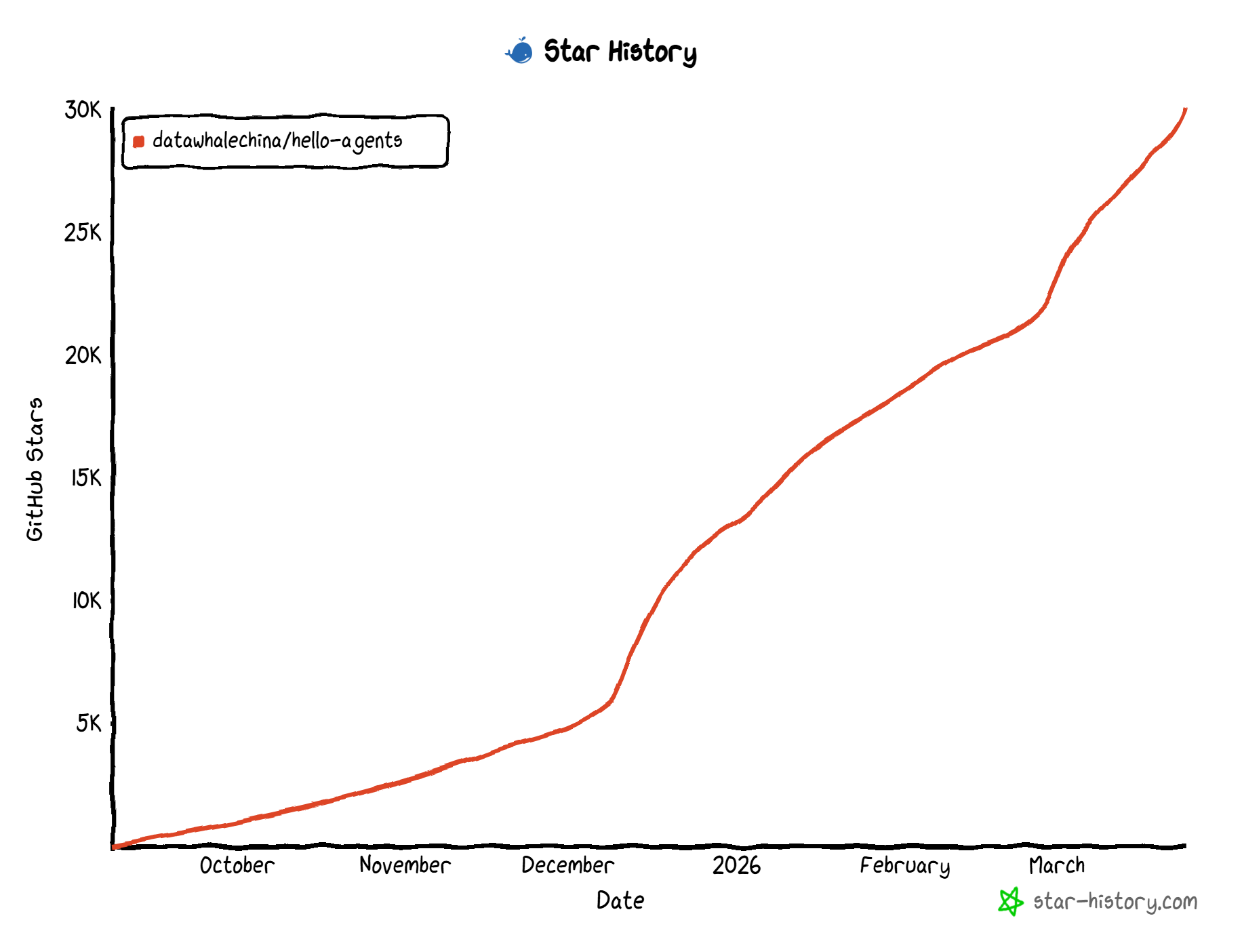
## Star History
⭐ If this project helps you, please give us a Star!
## Reader Community Group

Scan the QR code to join the reader community group and discuss with more learners
## About Datawhale

Scan the QR code to follow the Datawhale official account and get more quality open-source content
---
## 📜 Open Source License
This work is licensed under a [Creative Commons Attribution-NonCommercial-ShareAlike 4.0 International License](http://creativecommons.org/licenses/by-nc-sa/4.0/).